Sponsored article
When Are Eco-Friendly Plastics Suitable for Stable Injection Moulding, and When Do They Require Compromises?
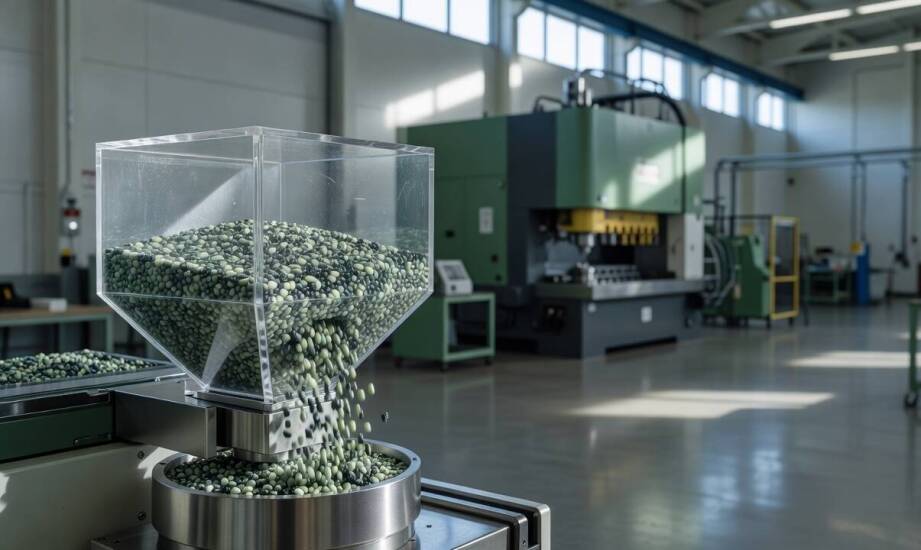
- How Do Recycled Plastics Affect Injection-Moulding Stability?
- Recycled Plastics and Bioplastics Are Not the Same Thing
- Does an Eco Material Automatically Reduce Carbon Footprint?
- How Should Materials Be Prepared Before Injection Moulding?
- Why Is Cooling Important for Dimensional Stability?
- When Can the Existing Mould Be Used?
- When Do Alternative Materials Require Technical Compromises?
- How Should a New Material Be Validated?
- What Should Quality Control Focus On?
- How Does Noex Work With Alternative Materials?
- When Can Eco Materials Be Used Without Major Compromise?
Introducing materials with a potentially lower environmental impact into industrial injection moulding requires more than simply replacing one polymer grade with another.
Read more: New Trends in Metal Processing Technology: The Role of Deburring
Recycled plastics, bio-based polymers and compostable materials can all be used successfully in series production, but their processing behaviour must be evaluated in relation to the actual application.
A new material may differ in melt-flow behaviour, shrinkage, thermal sensitivity or mechanical properties. These differences can affect dimensional stability, surface appearance and process repeatability.
This does not mean that alternative materials are inherently unstable.
The key is to determine whether the selected grade can meet the technical requirements of the component and whether the injection moulding process can be adapted to its characteristics.
How Do Recycled Plastics Affect Injection-Moulding Stability?
Mechanically recycled plastics have already passed through at least one previous production and recycling cycle.
Depending on the polymer, processing history and recycling conditions, repeated thermal and mechanical processing can change:
molecular weight;
melt flow rate;
crystallinity;
impact resistance;
elongation at break;
other mechanical properties.
However, recycled plastic should not automatically be considered more brittle or less stable than virgin material.
The actual result depends on many factors, including:
polymer type;
source of the recycled feedstock;
contamination level;
number of processing cycles;
additives and stabilisers;
processing temperature;
shear history.
Controlled industrial recyclates can therefore provide sufficiently consistent properties for series production.
The important point is to qualify the specific grade rather than make assumptions based only on the fact that it contains recycled material.
Recycled Plastics and Bioplastics Are Not the Same Thing
Bioplastics represent a broad group of materials and should not be treated as one homogeneous category.
A plastic can be:
bio-based;
biodegradable;
both bio-based and biodegradable.
Bio-based means that at least part of the material comes from renewable biomass.
It does not automatically mean that the product is biodegradable.
For example, bio-based PE or bio-based PET can be technically very similar to conventional PE or PET and may be processed using similar technologies.
Biodegradability is determined primarily by the chemical structure of the polymer rather than by whether its raw material originated from biomass.
Compostable plastics form an even more specific group.
They are designed to biodegrade under defined conditions, such as those found in industrial composting facilities.
This means that environmental claims should always be connected to the actual material and its intended end-of-life scenario.
A general statement that a material is “eco-friendly” is therefore not sufficient to determine either its processing behaviour or its overall environmental impact.
Does an Eco Material Automatically Reduce Carbon Footprint?
No.
Recycled or bio-based content can support sustainability objectives, but the actual environmental result depends on the complete lifecycle.
Relevant factors include:
raw-material production;
transport;
energy consumption;
processing;
product lifetime;
recycling or disposal route.
For this reason, claims about carbon-footprint reduction should be supported by appropriate data, such as a lifecycle assessment, rather than assigned automatically to an entire material category.
The same applies to blends containing recycled polymer and virgin material.
Such blends can be technically useful when they help achieve required mechanical or processing properties, but their environmental benefit depends on the actual composition and lifecycle of the product.
How Should Materials Be Prepared Before Injection Moulding?
Material preparation should be based on the characteristics of the specific polymer.
It is incorrect to assume that every recycled plastic absorbs more moisture than virgin resin or requires longer drying.
Moisture sensitivity depends primarily on polymer chemistry.
Hygroscopic materials may absorb water from the environment and require controlled drying before processing.
If excessive moisture is present in polymers susceptible to hydrolysis, degradation during melt processing may lead to problems such as:
loss of mechanical properties;
surface streaks;
bubbles;
reduced molecular weight.
Other polymers are much less hygroscopic and may not require the same drying procedure.
Recycled grades should therefore be checked according to their material specification, storage conditions and actual moisture content.
The same principle applies to bioplastics.
Some grades, including certain PLA-based materials, can be sensitive to moisture and processing temperature. Others, particularly bio-based drop-in polymers, may behave very similarly to their conventional equivalents.
Why Is Cooling Important for Dimensional Stability?
Cooling is one of the most important stages of injection moulding regardless of whether the material is virgin, recycled or bio-based.
Different polymers exhibit different shrinkage behaviour.
Semi-crystalline materials such as polypropylene generally behave differently from amorphous polymers because crystallisation influences dimensional change during cooling.
Changing from one grade to another can therefore affect:
shrinkage;
warpage;
flatness;
dimensional tolerances;
cycle time.
This does not mean that recycled polypropylene automatically shrinks more than virgin PP.
The behaviour depends on the specific grade, crystallinity, fillers, processing conditions and component geometry.
Uneven cooling can lead to significant warpage, particularly in parts with:
non-uniform wall thickness;
asymmetrical geometry;
large flat surfaces;
local accumulations of material.
For this reason, a material change may require validation of the existing cooling system and processing window.
When Can the Existing Mould Be Used?
Switching to an alternative material does not always require a new mould.
In many projects, the existing tool can continue to operate after the process has been adjusted.
Engineers may optimise:
melt temperature;
mould temperature;
injection speed;
holding pressure;
holding time;
cooling time.
However, if the new material has substantially different flow or shrinkage behaviour, the existing mould may limit the achievable quality.
In such cases, changes may be needed to:
gate geometry;
venting;
cooling circuits;
wall thickness;
ribs or reinforcement features.
This is why material selection should ideally be considered before the tool design is finalised.
When Do Alternative Materials Require Technical Compromises?
The answer depends on the component.
In some applications, a recycled or bio-based grade can replace a conventional polymer without any meaningful loss of performance.
In others, the design specification may need to change.
Possible compromises can involve:
colour consistency;
surface appearance;
very narrow dimensional tolerances;
impact strength;
thermal resistance;
chemical purity.
The decision should therefore be based on the actual function of the part.
Automotive Applications
Automotive components may be exposed to vibration, temperature variation, UV radiation or chemicals.
The relevant requirements depend strongly on whether the part is used inside the vehicle, in the engine compartment or on the exterior.
Recycled materials can be used where they meet the relevant performance specification.
They do not necessarily need to be blended with virgin polymer, although blending can be one way of tuning material properties in specific projects.
Construction Applications
Construction products can require long-term dimensional stability, weather resistance and UV durability.
For this reason, recycled grades should be selected according to the requirements of the particular component rather than according to recycled content alone.
Additives and stabilisers may be used when required to provide the necessary service life.
Laboratory Applications
Laboratory components can impose different requirements again.
Depending on the application, chemical purity, transparency, compatibility with samples and microbiological cleanliness may be more important than recycled content.
In highly sensitive applications, material selection therefore requires particularly careful validation.
This does not mean that alternative materials are excluded from laboratory products, but their suitability must be assessed for the intended use.
How Should a New Material Be Validated?
Before releasing a new polymer for large-scale production, manufacturers should carry out trial production under realistic processing conditions.
Validation can include:
dimensional measurements;
visual inspection;
mechanical testing;
functional tests;
monitoring of moulding pressure;
assessment of surface quality;
comparison between production cycles.
Measurements should sometimes be repeated after the component has reached dimensional and thermal equilibrium, particularly where crystallisation or post-mould shrinkage may influence final dimensions.
The purpose of the trial is to establish a stable processing window.
A single acceptable part does not prove that a material is ready for mass production.
The process must demonstrate repeatability across multiple cycles.
What Should Quality Control Focus On?
Quality control should be linked directly to the functional requirements of the product.
Typical criteria may include:
critical dimensions;
part weight;
visual appearance;
surface defects;
warpage;
mechanical performance;
assembly fit.
Changes in cavity pressure or other process parameters can indicate a change in material or process behaviour, but they should not automatically be attributed to one cause.
Variation may result from:
material viscosity;
temperature;
dosing;
machine condition;
moisture;
process settings.
For this reason, process data should be interpreted together rather than relying on one isolated indicator.
How Does Noex Work With Alternative Materials?
Noex processes a broad range of thermoplastics as well as recycled and biodegradable materials.
The company combines product development, prototyping, mould manufacture and injection moulding within one production environment.
Its ECO plastic products range includes solutions based on recycled, recyclable, bio-based and compostable materials.
This integrated approach is useful when introducing alternative polymers because changes to the component, mould or processing parameters can be evaluated within the same manufacturing workflow.
Noex also tests raw materials, production resources, components and finished products as part of its quality-control process.
When Can Eco Materials Be Used Without Major Compromise?
Alternative materials are most suitable for stable series production when:
their properties are clearly specified;
the supplier can provide consistent material quality;
the processing window is understood;
dimensional requirements match the material's behaviour;
the part is validated under production conditions.
The environmental classification of the polymer should be treated as one selection criterion rather than as the main engineering parameter.
A recycled or bio-based material can perform reliably in series injection moulding when its properties are matched to the component, mould and process.
Compromises become necessary mainly when the requirements of the product exceed the capabilities of the selected grade or when the material specification is too variable for the required tolerances.
For this reason, successful implementation depends less on whether a polymer is described as “eco” and more on whether its behaviour has been properly characterised, tested and controlled.
Article categories
You might be interested

Car detailing products – Where to start with regular car maintenance?
Taking care of a car is not only a matter of aesthetics but also a way to maintain its value over time. Systematic maintenance helps reduce wear and tear of parts and protects surfaces from external factors. The right approach to cleaning and preservation ensures that the car looks better and remain

Why do pork cheeks work well in slow-cooked dishes?
Dishes prepared over many hours continue to enjoy unwavering popularity in kitchens across various regions of the world. Slow cooking allows for the extraction of deep flavors and achieves the desired meat texture, which cannot be attained with quick cooking methods. This is why certain cuts are esp